
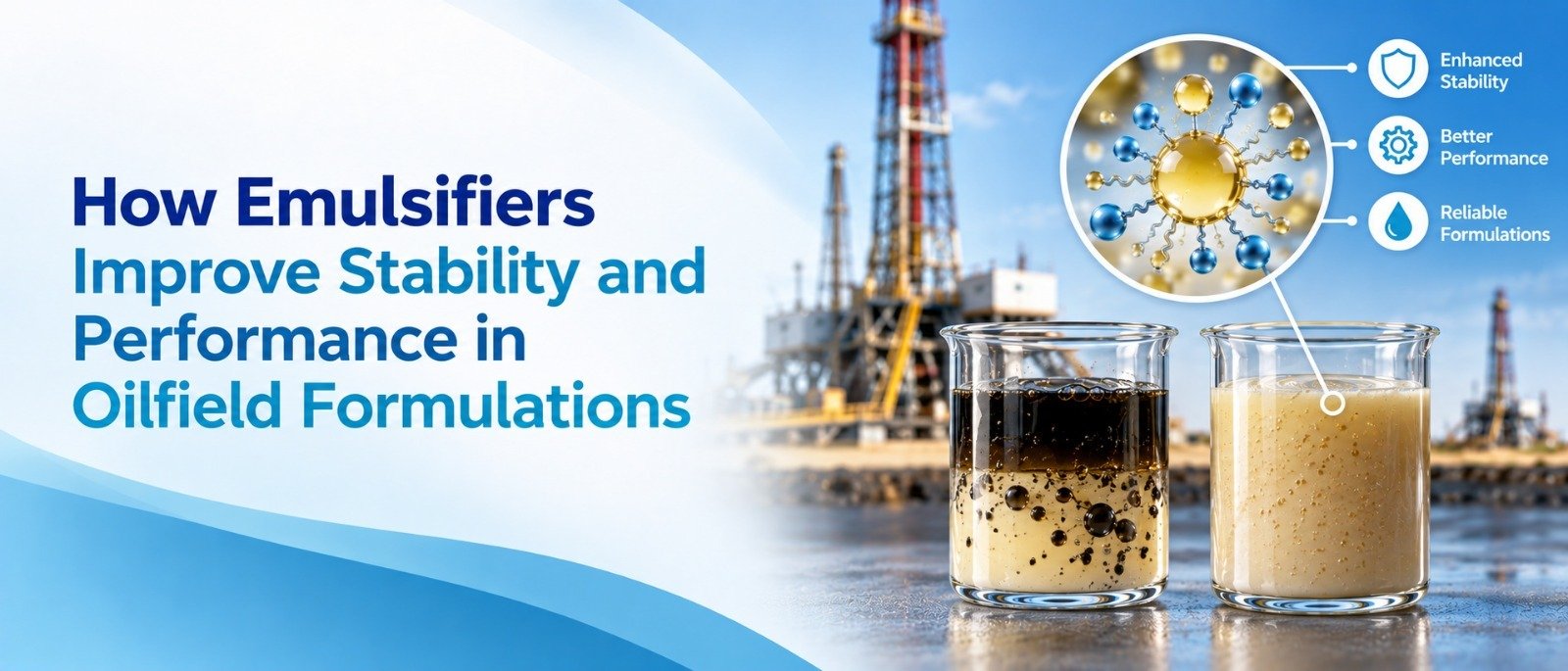
Oilfield formulations often contain multiple components that must work together under demanding conditions such as high temperatures, pressure variations, salinity, and prolonged exposure to downhole environments. Maintaining compatibility between oil and water phases is particularly important in drilling and production operations. Emulsifiers play a critical role in these systems by helping form and stabilize emulsions while supporting consistent fluid properties.
As an important category of oilfield chemicals, emulsifiers are widely evaluated for applications such as oil-based mud, synthetic-based mud, completion fluids, stimulation systems, and other specialty formulations used across the oil and gas industry.
What Are Emulsifiers in Oilfield Formulations?
Emulsifiers are surface-active chemicals that help combine and stabilize two immiscible liquids, typically oil and water. They position themselves at the interface between the two phases and reduce interfacial tension.
In oilfield applications, emulsifiers are particularly important in systems where a stable water-in-oil or oil-in-water emulsion is required.
For example, oil-based mud commonly uses a water-in-oil emulsion, where water droplets are dispersed throughout a continuous oil phase. The emulsifier helps maintain this structure during circulation and under changing downhole conditions.
How Do Emulsifiers Improve Oilfield Formulation Stability?
1. Stabilizing Oil-Water Interfaces
Oil and water naturally tend to separate. Emulsifiers reduce the interfacial tension between these phases and form an interfacial layer around dispersed droplets.
This helps limit droplet coalescence and supports a more stable emulsion. Maintaining this stability is important because changes in emulsion structure can affect the rheology, filtration, electrical stability, and overall performance of an oilfield formulation.
2. Supporting Consistent Drilling Fluid Properties
In oil-based and synthetic-based drilling fluids, maintaining consistent properties throughout drilling is essential.
A properly designed emulsifier system can help maintain the desired internal water-phase dispersion. This contributes to predictable mud behavior and helps drilling-fluid specialists manage properties such as viscosity, gel strength, fluid loss, and suspension.
3. Improving Compatibility Between Formulation Components
Oilfield formulations can contain a complex combination of base fluids, brines, weighting materials, organophilic additives, polymers, wetting agents, and other specialty chemicals.
Emulsifiers help facilitate compatibility between the oil and water components and can contribute to maintaining a stable formulation when these ingredients are present together.
4. Supporting Performance Under Downhole Conditions
Oilfield chemicals need to perform under conditions that can differ significantly from those encountered during laboratory formulation.
Temperature, pressure, salinity, contamination, and shear can influence emulsion stability. Selecting an emulsifier system suited to the expected operating environment can help maintain the desired formulation characteristics during circulation and downhole exposure.
Emulsifiers in Oil-Based Drilling Mud
One of the most established applications for oilfield emulsifiers is oil-based mud.
Oil-based mud generally contains a continuous oil phase and a dispersed aqueous phase. Primary and secondary emulsifier systems may be used to establish and maintain the water-in-oil emulsion.
A properly balanced emulsifier package can contribute to:
• Stable internal water-phase dispersion
• Improved electrical stability
• Consistent rheological properties
• Better tolerance to certain contaminants
• Controlled fluid loss
• Improved overall mud stability
The exact emulsifier selection and concentration depend on the base fluid, internal phase salinity, temperature, solids concentration, and other additives used in the mud.
Emulsifiers vs. Wetting Agents
Emulsifiers and wetting agents are both important oilfield additives, but their primary functions differ.
Emulsifiers primarily help create and stabilize the oil-water emulsion.
Wetting agents primarily promote the desired wetting of solid particles by the continuous oil phase.
In many oil-based mud systems, both may be used because emulsion stability and solids wetting are closely connected to overall mud performance.
Factors to Consider When Selecting Emulsifiers
Choosing an emulsifier for an oilfield formulation requires evaluation of several factors:
Base fluid: Mineral oils, synthetic fluids, and other base fluids can have different compatibility requirements.
Emulsion type: Determine whether the formulation requires water-in-oil or oil-in-water emulsion stability.
Temperature: Evaluate performance under expected downhole temperatures.
Salinity: The chemistry of the internal water phase can influence emulsifier performance.
Contaminants: Potential exposure to drilled solids, cement, formation fluids, or other contaminants should be considered.
Compatibility: The emulsifier should work effectively with wetting agents, fluid-loss additives, rheology modifiers, weighting materials, and other oilfield chemicals.
Dosage: Optimum concentration should be established through laboratory testing and application-specific evaluation.
Frequently Asked Questions
What are emulsifiers used for in oilfield formulations?
Emulsifiers are used to create and stabilize oil-water emulsions in systems such as oil based and synthetic-based drilling fluids.
Why are emulsifiers important in oil-based mud?
They help maintain the water-in-oil emulsion, support consistent mud properties, and contribute to overall drilling-fluid stability.
What is the difference between an emulsifier and a wetting agent?
An emulsifier primarily stabilizes the oil-water interface, while a wetting agent promotes the desired wetting of solid particles by the continuous phase.
How do you select an emulsifier for oilfield applications?
Selection should consider the base fluid, emulsion type, temperature, salinity, contaminants, compatibility with other additives, and required performance. Laboratory testing is recommended before field application.
Conclusion
Emulsifiers are essential components of many oilfield formulations, particularly where stable oil-water emulsions are required. By reducing interfacial tension and stabilizing
dispersed droplets, they help maintain formulation consistency and support important properties such as rheology, fluid loss, electrical stability, and solids suspension.
For drilling-fluid and oilfield chemical manufacturers, selecting the right emulsifier requires an understanding of the complete formulation and operating environment. Proper compatibility testing, dosage optimization, and evaluation under representative conditions can help ensure reliable performance in demanding oil and gas applications.