
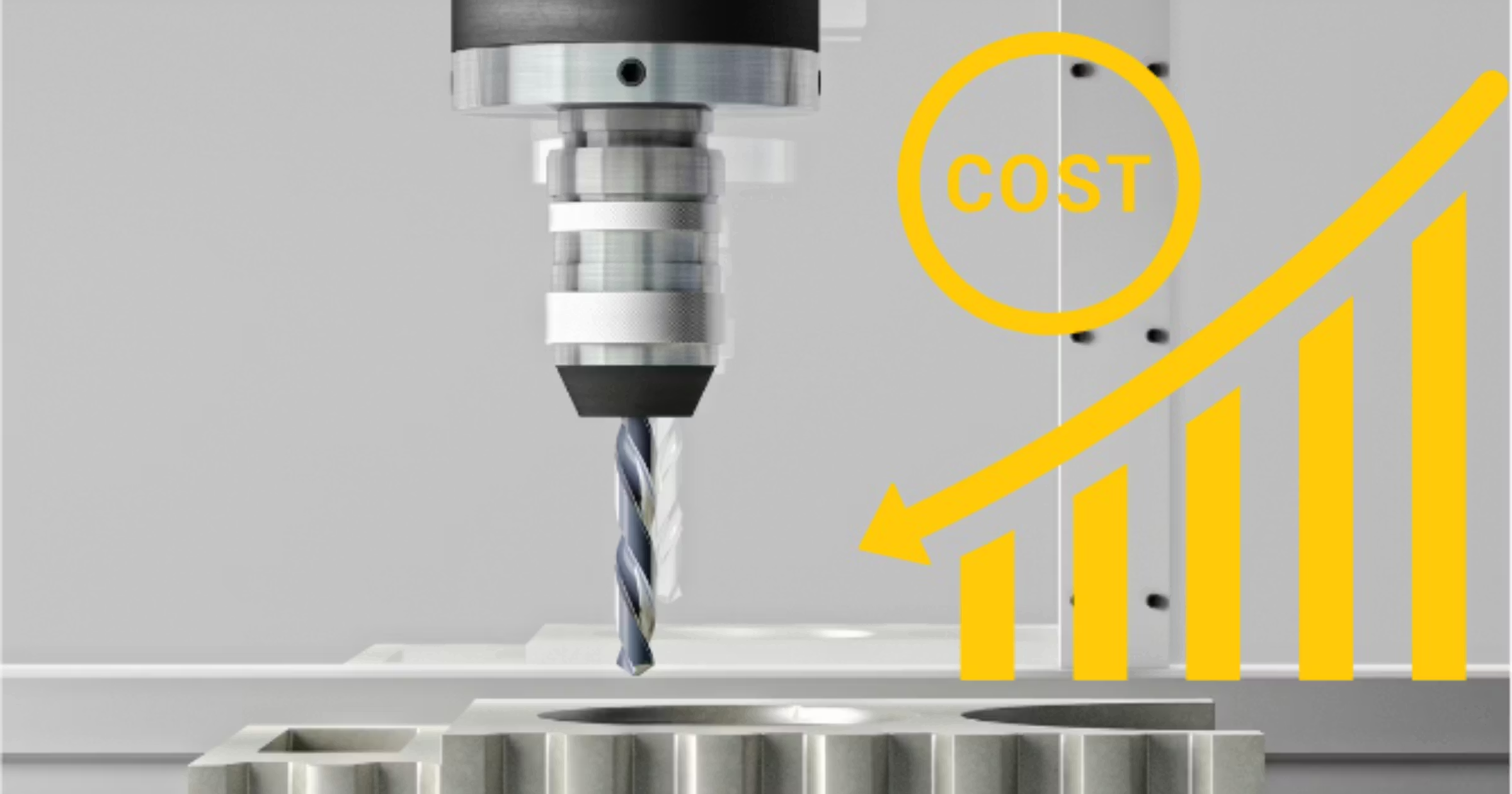
CNC machining costs can significantly impact product viability. A well-designed part that’s expensive to manufacture limits market opportunities. Conversely, thoughtful design and smart manufacturing strategies control costs while maintaining quality and performance.
Understanding cost drivers in CNC machining enables engineers to make design decisions that balance functionality with manufacturability. Collaborating with an experienced custom parts manufacturer provides insights into cost-effective design approaches and manufacturing strategies that optimize both part performance and production economics.
Primary Cost Drivers in CNC Machining
CNC machining costs break down into several major components:
Material Costs Raw material represents 20-40% of total part cost depending on complexity. Material prices vary dramatically—aluminum costs $3-5/pound, titanium $15-30/pound, PEEK plastic $50-100/pound. Material selection profoundly impacts cost.
Beyond unit price, material utilization matters. A part machined from 2-pound block but weighing 0.5 pounds waste generates 1.5 pounds of scrap. High-cost materials amplify waste impact—$45 of titanium scrap per part versus $4.50 of aluminum scrap.
Machine Time Machine hour rates vary by equipment type and location. Basic 3-axis mills run $60-100/hour; 5-axis machines cost $150-250/hour. Machining time directly multiplies by these rates to determine labor costs.
Cycle time depends on complexity, material, tolerances, and surface finish requirements. Simple parts might machine in 15 minutes; complex parts require hours. Setup time adds 30 minutes to 2+ hours per batch depending on complexity.
Tooling Costs Cutting tools wear during machining and require periodic replacement. A carbide endmill costs $15-100 depending on size and quality. Tool life varies by material—an endmill might complete 50 aluminum parts or only 10 stainless steel parts before replacement.
High-volume production amortizes tool costs across many parts. Low-volume runs concentrate tool costs on fewer parts. Difficult materials like titanium or Inconel accelerate tool wear, increasing per-part tool costs significantly.
Secondary Operations Finishing operations add cost beyond basic machining. Deburring, anodizing, powder coating, or assembly operations require additional labor and outside processing. Complex finishes can double or triple part costs compared to as-machined parts.
Design Strategies for Cost Reduction
Smart design decisions minimize manufacturing costs:
Simplify Geometries Complex features require longer cycle times and sophisticated programming. Simple prismatic shapes machine faster than organic curves. Square pockets mill quicker than circular pockets. Straight holes drill faster than angled holes.
Evaluate every feature: Does this complexity serve a function, or is it aesthetic preference? Eliminating unnecessary complexity reduces cycle time and costs without compromising performance.
Optimize Tolerances Every tolerance reduction increases cost. Standard ±0.005″ (±0.13mm) tolerances machine efficiently. Tightening to ±0.002″ (±0.05mm) requires additional operations and verification. ±0.0005″ (±0.013mm) demands grinding or secondary processes.
Apply tight tolerances only where function demands. General features tolerate ±0.010″ happily. Mating surfaces might need ±0.002″. Only bearing fits or precision assemblies justify ±0.0005″. Appropriate tolerance selection saves significant costs without impacting part performance.
Minimize Setups Each workpiece repositioning adds setup time and introduces error. Design parts machinable from one or two sides when possible. Features on multiple faces require flipping the part, adding time and potential misalignment.
Consider alternative designs that consolidate features. Sometimes splitting a complex part into two simple parts reduces total cost despite requiring assembly. Each situation requires analysis, but minimizing setups generally reduces costs.
Use Standard Tools Custom form tools or special endmills cost hundreds of dollars and extend lead time. Standard tools—available off the shelf—cost less and work reliably. Design features compatible with standard tool sizes whenever possible.
Standard hole sizes match available drill bits. Standard radii match available endmill corner radii. Custom requirements force special tool procurement, increasing cost and lead time unnecessarily.
Material Selection The cheapest suitable material usually optimizes costs. Aluminum costs less than stainless steel; stainless less than titanium. Free-machining grades (6061 aluminum, 303 stainless, 12L14 steel) reduce cycle times compared to difficult grades.
Don’t over-specify materials. If 6061-T6 aluminum provides adequate strength, avoid 7075-T6. If mild steel suffices, don’t specify alloy steel. Match material to requirements without excessive margins—safety factors belong in design calculations, not material selection.
Reduce Material Volume Parts requiring less material cost less—both in raw material and machining time. Can wall thickness reduce without compromising strength? Can pockets deepen to remove weight? Every pound removed saves material cost and machining time.
Weight reduction particularly benefits expensive materials. Removing a pound from a titanium part saves $20-30 in material while reducing machining time since less material requires removal.
Production Volume Considerations
Cost optimization strategies vary by volume:
Prototype and Low Volume (1-10 parts) Setup time dominates costs at low volumes. Simple fixtures and programming reduce setup costs more than cycle time optimization. Standard materials and relaxed tolerances minimize programming complexity and setup time.
Manual operations sometimes cost less than automated processes at low volumes. Hand deburring 10 parts takes 30 minutes; designing a deburring fixture takes hours. At low volumes, manual methods prove more economical.
Medium Volume (10-100 parts) Setup cost amortization begins mattering. Custom fixtures might justify their cost across 50 parts. Programming optimization reduces cycle time profitably. Dedicating attention to efficient toolpaths and cutting parameters returns savings across the batch.
Standard tooling still makes sense, but custom tools might justify costs for particularly complex features or tight tolerances that would otherwise require multiple operations.
High Volume (100+ parts) All optimization becomes worthwhile. Custom fixtures, dedicated programs, optimized tooling, and even custom tools justify their costs across hundreds of parts. Cycle time reduction of even seconds per part saves significant money in high-volume production.
Consider alternative processes at high volumes. Investment casting, die casting, or progressive die stamping might cost less per part despite high tooling investment. Working with an experienced custom parts manufacturer helps evaluate alternatives when volumes justify process selection analysis.
Value Engineering Approaches
Systematic cost reduction employs value engineering:
Design Review Manufacturers often identify cost-reduction opportunities customers miss. Form, fit, and function reviews examine each feature: What does this feature do? Can simpler geometry achieve the same function? Can tolerance relax without impacting assembly?
Collaborative design review between engineering and manufacturing teams finds cost reductions maintaining or improving functionality. Fresh perspectives identify alternatives original designers didn’t consider.
Material Substitution Alternative materials sometimes provide equivalent performance at lower cost. Brass instead of stainless for non-corrosive environments. Aluminum instead of steel where strength permits. Engineering plastics instead of metals where electrical insulation or light weight matter.
Material substitution requires engineering validation—mechanical testing, environmental exposure, or accelerated life testing. But successful substitutions yield recurring savings throughout product life.
Process Optimization Manufacturing process improvements reduce costs: Better toolpaths reduce cycle time. Improved coolant application extends tool life. Optimized cutting parameters balance material removal rate against tool wear.
Process optimization requires expertise and experimentation. Shops investing in process improvement develop efficient approaches benefiting all customers through lower costs and faster turnaround.
Batch Optimization
Production quantity affects per-part costs:
Setup Amortization Setup time—1 hour on average—costs the same whether machining 1 part or 100 parts. Producing 10 parts instead of 1 reduces per-part setup cost from $100 to $10. Consider producing multiple parts even when not immediately needed if you’ll need them eventually.
Tool Life Management Tools last through specific part counts. Producing 49 parts wastes tool life if the tool could complete 100 parts before replacement. Producing 101 parts requires two tool sets. Batch sizes aligning with tool life optimize tool costs.
Vendor MOQs Outside processing—anodizing, plating, heat treating—often carries minimum order quantities or charges. Finishing 10 parts might cost the same as finishing 30 parts due to MOQs. Batch sizes should consider secondary operation economics, not just machining costs.
Conclusion
CNC machining cost optimization balances numerous factors—design complexity, tolerance requirements, material selection, and production volume. No single strategy fits all situations, but understanding cost drivers enables intelligent decisions. Engineers designing with manufacturing in mind create parts that perform excellently while controlling costs. Manufacturing partners contributing value engineering identify opportunities original designs miss. Together, thoughtful design and smart manufacturing create products that succeed both functionally and economically.