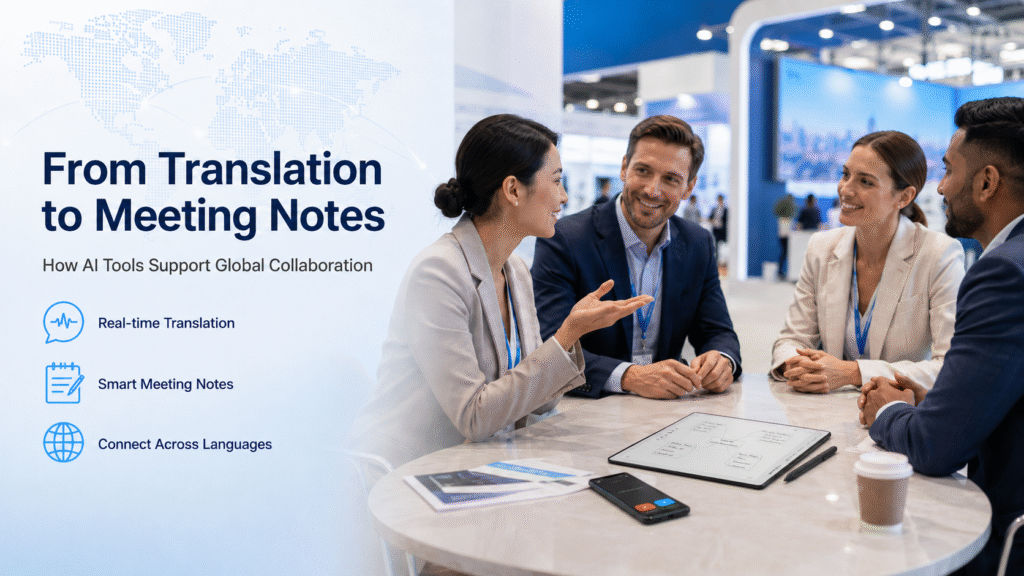
Global collaboration no longer happens only in boardrooms or conference calls. It now happens across trade shows, supplier visits, client workshops, remote team meetings, and follow-up conversations between people in different countries. These moments can create real business value, but they also create a practical challenge: teams must understand each other clearly, capture the right details, and turn conversations into useful next steps.
This is where AI tools are becoming more important. Tools such as iFLYTEK Translator help professionals communicate across languages, while AI note-taking tools help them organize what was said afterward. When these two areas work together, professionals can move from conversation to record, and from record to action, with less friction.
Global Work Creates More Communication Pressure
International teams often deal with more complexity than local teams. A single project may include a manufacturer in one country, a sales team in another, and a client in a third market. Each group may have different expectations around timing, decision-making, and communication style.
Language is only one part of the challenge. Professionals also need to understand technical details, pricing conditions, delivery timelines, customer feedback, and project risks. A smart notebook such as AINOTE 2 can help teams keep these details easier to capture, organize, and revisit, so fewer important points get lost after the conversation ends.
Translation Is the First Step
Before teams can collaborate effectively, they need to understand each other. In cross-border meetings, even small language gaps can slow down the conversation. A participant may understand the general meaning but miss a condition, timeline, or technical term. In business settings, those details matter.
A dedicated translation tool can help keep discussions moving. Instead of stopping to type into a phone or waiting for someone to explain each point manually, professionals can use real-time translation support during meetings, client visits, trade shows, or supplier discussions. A tool such as iflytek translator can fit into this workflow by helping users communicate more directly when language barriers appear during face-to-face business conversations.
The goal is not to replace human communication skills. The goal is to reduce the gap between hearing something and understanding it well enough to respond.
Meeting Notes Preserve the Value of the Conversation
Understanding the conversation is only the beginning. After the meeting ends, teams still need to remember what was discussed, what was decided, and what must happen next. This is where many global teams lose momentum.
A meeting may include useful ideas, but if those ideas stay in rough notes or scattered chat messages, they are hard to act on. A buyer may share product concerns during a trade show. A partner may mention a condition for cooperation. A client may ask for a revised proposal by a certain date. If these details are not captured clearly, the opportunity can fade.
Good meeting notes should record the key points and organize the meaning behind them. Professionals need to separate confirmed decisions from open questions, risks from general comments, and action items from background discussion.
AI Helps Turn Notes Into Structure
AI note-taking tools can make this process easier by helping professionals capture, summarize, and organize meeting information. Instead of relying only on memory or manual cleanup, users can review structured notes after the conversation. This makes it easier to identify main topics, follow-up tasks, deadlines, and unresolved issues.
A smart notebook such as ainote 2 can support this workflow by combining handwriting with AI-assisted organization. For many professionals, handwriting still feels natural during meetings because it allows quick sketches, short phrases, and flexible thinking.
From Live Translation to Follow-Up
The strongest workflow connects translation and notes instead of treating them as separate tasks. During a meeting, translation support helps participants understand each other in real time. During and after the meeting, AI notes help preserve the discussion and prepare the next step.
For example, a foreign exhibitor at a trade show may use translation support to answer visitor questions, then record customer needs and follow-up details in a digital notebook. A sourcing manager visiting a factory may use translation support during a technical discussion, then organize supplier commitments afterward.
This connection matters because business collaboration does not end when people understand each other. It ends when the right actions are taken. Translation opens the conversation, but organized notes keep the value of that conversation from being lost.
Keep Documents and Notes Connected
Global collaboration often includes documents as well as speech. Teams may discuss contracts, price sheets, product specifications, brochures, slide decks, or technical drawings. If meeting notes are separated from these materials, important context can disappear.
A better approach is to keep documents and notes connected. When reviewing a contract, professionals can mark the clause that needs legal review. When discussing a product sheet, they can note which specification created concern. When preparing a follow-up proposal, they can return to the exact customer request instead of relying on memory.
Choosing AI Tools for Global Collaboration
The best AI tools are the ones that support real work habits. A translation tool should be simple enough to use during live conversations. A note-taking tool should be comfortable enough for regular meetings and organized enough for later review. Professionals should look for tools that reduce friction instead of adding another complicated step.
For teams that work internationally, the most useful setup is one that connects live communication with organized follow-up. Translation support helps conversations move forward in the moment, while AI note-taking helps preserve the details that matter afterward. Used together in the broader workflow, these tools can help professionals move more smoothly from conversation to decision.
Final Thoughts
Global collaboration depends on more than good intentions. People need to understand each other, capture the right details, and follow through after the meeting ends. When language barriers and scattered notes get in the way, even a promising business conversation can lose its value.
AI tools can support both sides of the process. Translation makes communication clearer in the moment, while AI note-taking makes information easier to organize afterward. This combination can turn international conversations into clearer decisions and more reliable business outcomes.